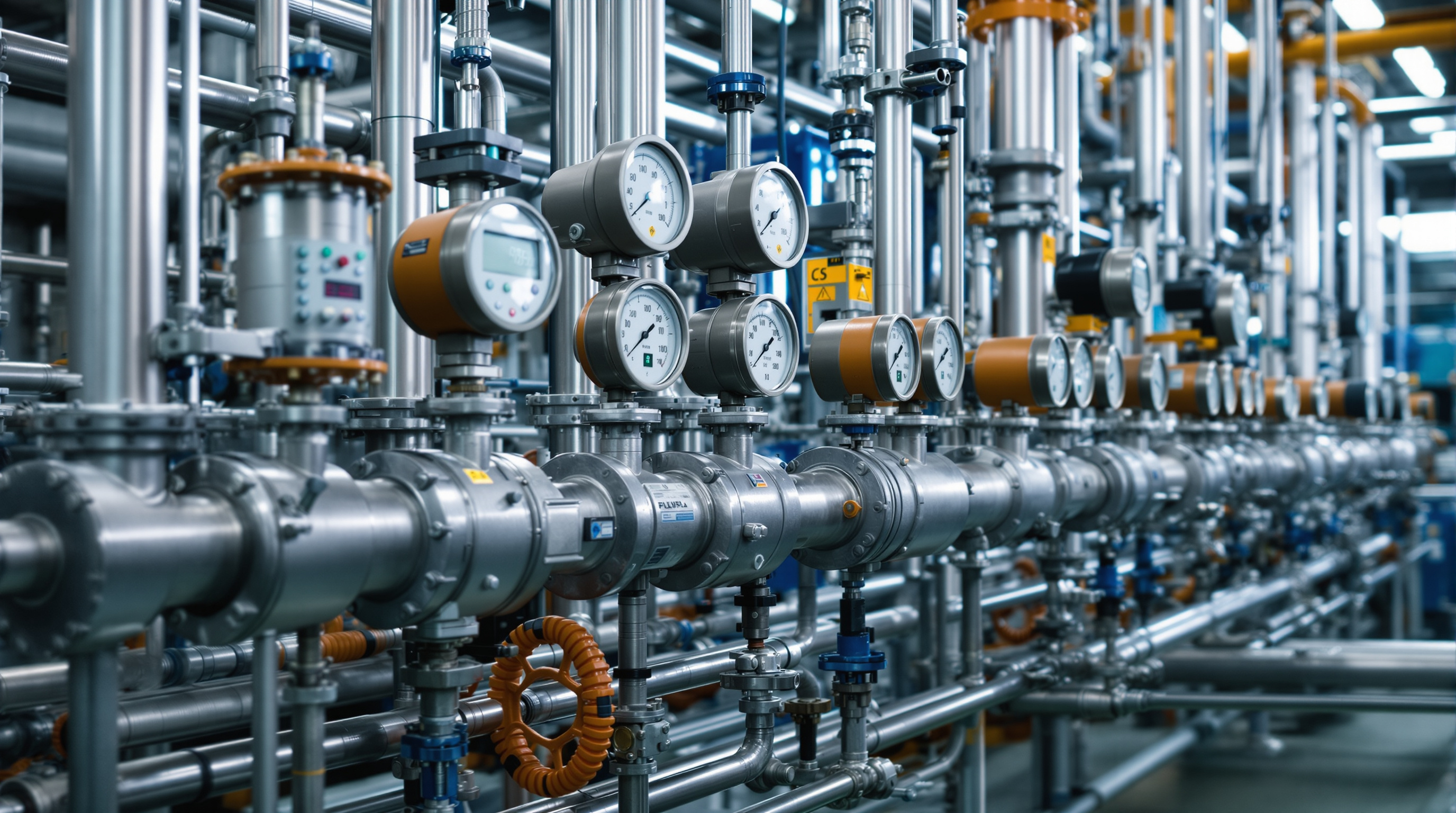
There is no universal flow meter. Each technology trades accuracy, cost, pressure loss, fluid compatibility and maintenance differently. This page tours the major families so you can see, at a glance, which principles suit which duties. For depth on any one, follow the links to its dedicated page.
Positive-Displacement (PD)
PD meters trap discrete, known volumes of fluid in a rotating mechanism — oval gears, a rotary piston, a nutating disc — and count them. Because they physically meter volume rather than infer it from velocity, they need no straight pipe run and actually get more accurate as viscosity rises. That makes them the default for oils, fuels and hydraulic fluids. Trade-offs: moving parts wear, they cannot tolerate solids, and they impose a pressure drop. Typical accuracy ±0.1% to ±0.5% of reading. See positive-displacement meters.
Electromagnetic (Magnetic / "Mag")
A mag meter applies Faraday's law of induction: a conductive liquid moving through a magnetic field generates a voltage proportional to its velocity. With no moving parts and no obstruction, it has zero pressure drop, handles slurries and dirty water, and lasts for decades. The catch: the fluid must be electrically conductive, so hydrocarbons, oils and pure water are out. Typical accuracy ±0.2% to ±0.5% of reading. See electromagnetic meters.
Turbine
A rotor spins at a rate proportional to flow velocity; a pickup counts blade passes. Turbine meters are accurate and repeatable on clean, low-viscosity liquids and gases, with fast response and wide rangeability. They dislike dirt, viscosity and flow surges, and bearings wear. Common in aviation fuel, water and clean process lines.
Coriolis
The gold standard for high-value measurement. An oscillating tube twists in proportion to the mass flowing through it (the Coriolis effect), giving a direct mass reading independent of density, plus density and temperature as bonuses. Accuracy reaches ±0.1% of reading or better. The downsides are cost, weight and size, especially at large line sizes.
Ultrasonic
Transit-time ultrasonic meters send pulses diagonally upstream and downstream; the time difference reveals velocity. They are non-intrusive — often clamp-on, with no wetted parts — ideal for clean liquids and retrofit. Doppler versions bounce sound off particles or bubbles and suit dirty fluids instead. No pressure drop; accuracy depends heavily on installation and pipe condition.
Vortex
A bluff body in the flow sheds vortices at a frequency proportional to velocity (the von Kármán effect). Vortex meters handle steam, gas and liquids with no moving parts and good stability, but they need a minimum velocity to shed vortices, so they struggle at low flow.
Variable-Area (Rotameter)
A float rises in a tapered tube until drag balances weight; its height indicates flow. Simple, cheap, self-powered and easy to read at a glance, rotameters are everywhere in purge and indication duties, at the cost of modest accuracy and a vertical-mounting requirement.
Differential Pressure (Orifice, Venturi, Nozzle)
Constrict the flow and measure the pressure drop; by Bernoulli's principle, flow is proportional to the square root of that drop. DP metering is the oldest and still one of the most widespread methods, governed by international standards such as ISO 5167. It is robust and well understood but has limited turndown (the square-root law compresses low-flow resolution) and a permanent pressure loss.
Thermal Mass
A heated element in the flow stream loses heat to the fluid passing it; the power needed to hold that element at a set temperature above ambient — or the temperature difference across a pair of elements — is proportional to mass flow. Thermal meters therefore read gas mass directly, need no separate pressure and temperature compensation, and resolve remarkably low flows, which makes them the default for compressed-air surveys, flare and vent lines, and laboratory gas control. The catch is gas dependence: the calibration belongs to a specific gas, so a meter set up for air will misread a hydrocarbon or a shifting mixture, and neither condensate nor dust is tolerated well.
Quick Comparison
| Technology | Measures | Best for | Avoid with | Typical accuracy |
|---|---|---|---|---|
| Positive displacement | Volume | Oils, fuels, viscous liquids | Solids, water-thin low-lubricity fluids | ±0.1–0.5% rd |
| Electromagnetic | Velocity→volume | Conductive water, slurry, wastewater | Hydrocarbons, non-conductive fluids | ±0.2–0.5% rd |
| Turbine | Velocity→volume | Clean low-viscosity liquids/gas | Dirty or viscous fluids | ±0.1–0.5% rd |
| Coriolis | Mass | Custody transfer, dosing, density | Tight budgets, very large lines | ±0.1% rd |
| Ultrasonic | Velocity→volume | Retrofit, clean liquids, large pipes | Poor pipe/coupling, heavy aeration | ±0.5–2% rd |
| Vortex | Velocity→volume | Steam, gas, hot liquids | Low flow, high viscosity | ±0.7–1% rd |
| Thermal mass | Mass (gas) | Compressed air, flare/vent, lab gas | Changing gas mix, condensate, dust | ±1–2% rd |
Use the selection guide to turn this comparison into a decision for your fluid and duty.